

Every term, schools across the UK run a fire drill roll call. Workplaces run theirs too, on their own schedule. The alarm sounds, everyone files outside, and a member of staff works through a printed register or a clipboard list, ticking off names as they go. It is a familiar routine, and for most organisations it works well enough, because a drill is planned. Everyone knows it is coming.
A real evacuation does not give that warning. Visitors are mid-meeting. Contractors are in a plant room or on the roof. A delivery driver is waiting in reception. Pupils and staff have moved between classrooms since the register was last checked. The person responsible for the roll call is left reconstructing who is actually on site from memory and a paper trail that was already out of date before the alarm went off.
What’s changing in 2026
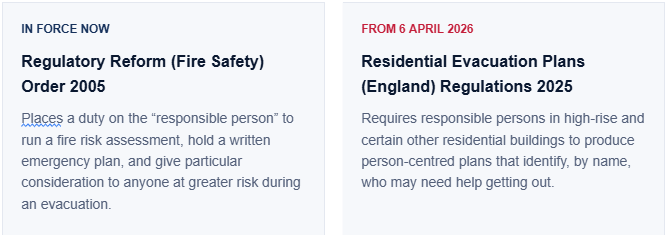
2026 is bringing that gap into sharper focus. The Regulatory Reform (Fire Safety) Order 2005 already places a legal duty on schools and workplaces, as the “responsible person,” to carry out a fire risk assessment, put a written emergency plan in place, and give particular consideration to anyone who may be at greater risk during an evacuation. The Order itself does not set a fixed drill schedule or name individual Personal Emergency Evacuation Plans (PEEPs) as a requirement. Termly fire drills and named PEEPs for pupils or staff who need tailored support are what fire safety guidance and sector good practice recommend as the way schools demonstrate they are meeting that duty, and it is this kind of evidence that Fire and Rescue Services will look for during an inspection.
Separately, the Fire Safety (Residential Evacuation Plans) (England) Regulations 2025, come into force on 6 April 2026 (full regulations), requiring responsible persons in high-rise and certain other residential buildings to produce person-centred evacuation plans that identify, by name, who may need help getting out. It is a different regulation covering a different type of building, but the direction is hard to miss: UK fire safety policy is moving away from generic procedures and towards named, individual-level accountability for who is on a site, and whether they got out safely.
For most organisations, the honest answer to “who is on site right now” still lives in a paper visitor book, a whiteboard, or a spreadsheet that gets updated once a day rather than once a minute. That is a difficult position to be in during an actual emergency, and an uncomfortable one to explain afterwards, whether to a fire inspector, a governing body, or a worried parent.
How the Emergency List works
This is the gap VisiPoint’s Emergency List is built to close. It pulls together everyone currently signed in through VisiPoint, whether a visitor, contractor, delivery, or staff member, into a single live list, accessed from the top right of the dashboard or from any device with a browser. Each entry shows a photo for quick identification, along with department and area, so the list can be filtered down to a specific building or zone during an evacuation rather than searched through in full.
During a roll call, whoever is running it simply checks each person off as “found,” and because the list supports multiple devices at once with real-time updates, several staff members can run the count from different assembly points without duplicating or missing anyone. Every roll call is logged as a session, with a start and end time, so schools already keeping a fire logbook under the 2005 Order have a timestamped record to sit alongside it. Schools with VisiPoint’s optional MIS integration enabled can also pull in students currently marked present in their MIS (management information system), so the emergency list reflects the same attendance data the school already relies on day to day.
| ● Photo identification Each entry shows a photo, so people can be identified at a glance during a roll call. | ● Filter by building or zone Narrow the list to a specific building or area instead of searching the whole site. | ● Multi-device, real time Several staff can run the count from different assembly points at once, without duplicating anyone |
| ● Timestamped sessions Every roll call logs a start and end time, alongside any fire logbook kept under the 2005 Order. | ● Optional MIS integration Schools can pull in students currently marked present in their MIS, matching day-to-day attendance data. | ● Kiosk print shortcut A physical copy of the list can be printed straight from the kiosk when it is needed. |
You can see exactly how the feature works, including the kiosk shortcut for printing a physical copy, in VisiPoint’s help guide: How to Use the Emergency List for Roll-Calls and Fire Drills.